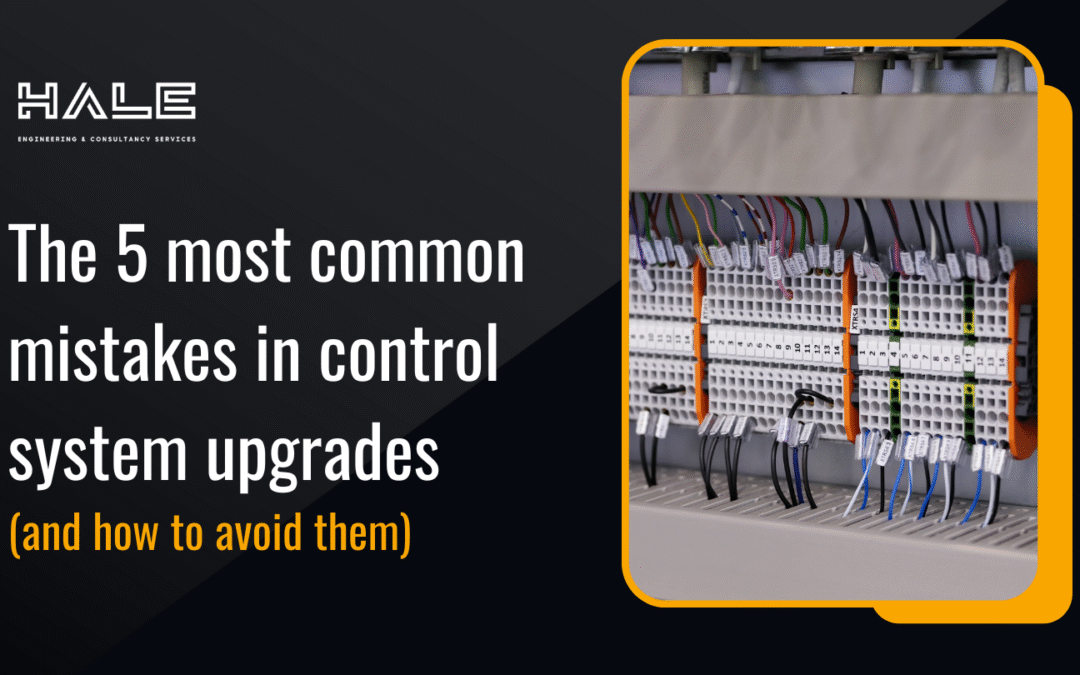
Modern plants depend on automation that works flawlessly — but when it’s time to upgrade, many organisations underestimate just how complex, high-risk, and interdependent their control systems really are.
A PLC or SCADA upgrade isn’t just swapping hardware. It affects safety, compliance, production continuity, quality assurance, data integrity, and even operator confidence.
Through years of supporting high-stakes industries — from manufacturing and pharmaceuticals to recycling and utilities — five mistakes come up time and time again. The good news? They’re all avoidable.
1. Upgrading the hardware without reviewing the process logic
Many plants replace PLCs or HMIs but leave the original logic untouched.
This is one of the most costly long-term errors.
Why it’s a problem:
-
The old logic was written for different production targets and safety expectations.
-
Legacy code often contains temporary fixes that became permanent risks.
-
Modern hardware can’t deliver its full value if the underlying logic is outdated.
How to avoid it:
Always pair a hardware upgrade with a logic audit — reviewing interlocks, safety functions, failsafes, and sequence flow. Modernisation should mean improvement, not replication of old issues.
2. Treating I/O mapping as a “copy and paste” exercise
Replacing like-for-like seems simple… until it isn’t.
Common pitfalls:
-
Incorrectly assigned channels
-
Overlooked sensors or valves added over the years
-
Missing documentation on temporary bypasses
-
Safety circuits mapped incorrectly
How to avoid it:
A disciplined I/O verification phase with full field testing. If your I/O sheets haven’t been updated in a decade (a common scenario), rebuild them properly before commissioning begins.
3. Underestimating integration with existing systems
Plants rarely run on one neat system. You have:
-
SCADA platforms
-
VFDs
-
Robotics and motion control
-
Safety relays
-
External plant networks
-
Historian servers
-
Remote monitoring systems
A control system upgrade that ignores one of these leads to communication failures, inconsistent data, and downtime.
How to avoid it:
Create an integration matrix before starting the upgrade. Every connected device, network, data point, and protocol should be mapped, tested, and validated.
4. Rushing commissioning and skipping proper testing
When deadlines get tight, commissioning is often squeezed. This is where major problems are born.
Typical outcomes of rushed commissioning:
-
Inconsistent sequence performance
-
Alarms that don’t activate or never clear
-
Safety-related behaviours that fail under load
-
Operators losing trust in the system
-
Endless “post-upgrade fixes”
How to avoid it:
Build in time for structured FAT and SAT, test plans, simulation where possible, and step-by-step validation with the operations team.
Well-planned commissioning reduces risk far more than expensive call-outs later.
5. Failing to future-proof the system
You’re not just upgrading for today — you’re upgrading for the next decade.
Common oversights:
-
Choosing a platform already nearing end-of-life
-
Ignoring spare I/O for future expansion
-
Not planning for cybersecurity requirements
-
No roadmap for software updates
-
No thought for operator training or maintenance handover
How to avoid it:
Treat your upgrade as part of a long-term automation strategy. Build scalability into your architecture and ensure every upgrade contributes to a stronger, safer, more resilient plant.
Why do these mistakes happen?
Most of these problems stem from one assumption:
“It’s just a PLC upgrade — we can handle it with our internal team.”
But modern automation isn’t what it was 15 years ago.
Systems are more interconnected, more regulated, more software-driven, and more safety-critical than ever.
Without a senior engineer-led approach, small oversights snowball into expensive, production-stopping failures.
The engineer-led solution: how Hale Engineering prevents these mistakes
Hale Engineering Consulting specialises in mission-critical, no-shortcut automation upgrades.
Our approach removes the risks that lead to the five problems above.
Here’s how:
-
Full-lifecycle consulting: From audits and concept design to programming, testing, and long-term optimisation.
-
Deep PLC expertise: Siemens, Allen Bradley, Mitsubishi, Omron — no guesswork, no trial and error.
-
Documented I/O mapping and verification: Every channel is tested, traced, and validated.
-
Robust commissioning: Structured FAT, SAT, simulation, and step-by-step handover.
-
Future-proof architecture: Scalable, safe, compliant, and built around your operational goals.
-
Engineer-led problem solving: Real answers, not sales pitches — and 24/7 troubleshooting when it counts.
We don’t just upgrade systems.
We upgrade performance, reliability, and operational confidence.
If you’re planning a PLC or SCADA upgrade — or battling recurring faults that never seem to go away — now is the moment to bring in specialist support.
Hale Engineering Consulting ensures your upgrade is safe, compliant, future-ready and engineered correctly the first time.
No shortcuts. No surprises. No unnecessary downtime.
Contact Hale Engineering to design, audit, or deliver your next control system upgrade — and avoid the mistakes that cost most plants time, money, and safety.