
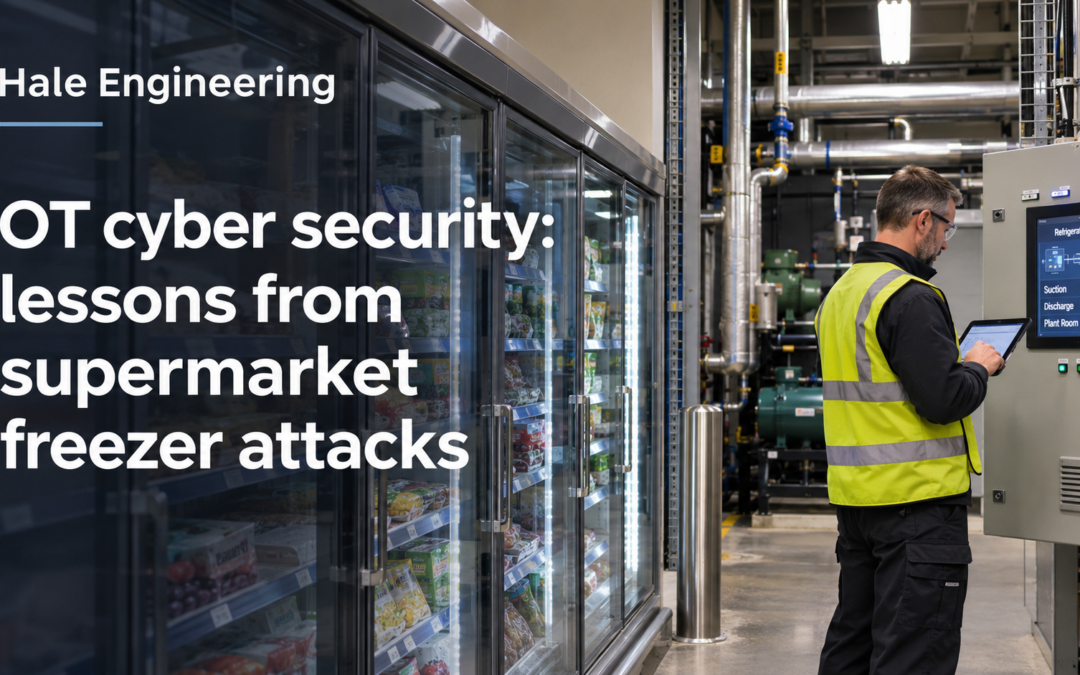
What supermarket freezer attacks mean for industrial OT cyber security, supplier remote access, safety protection and recovery planning?
If you manage an industrial site or its control systems, you face a difficult balancing act: keeping production running while maintaining equipment, supporting supplier access and managing ageing technology. OT cyber security becomes harder when responsibility is divided between engineering, IT and external contractors. This IT/OT gap in manufacturing can leave nobody with a complete picture of how equipment connects to the outside world.
The recent supermarket refrigeration attacks demonstrate why those gaps deserve attention. For site managers and controls engineers, the practical question is whether similar exposure exists within their own plant.
Why refrigeration attacks matter to industrial sites?
Reporting on 2 November 2026, the Financial Times described another wave of attacks on European supermarket refrigeration, following incidents in France in October. Freezers reportedly reached temperatures as high as 55°C. A refrigeration supplier said attackers had targeted defrost functionality, while Danfss reiterated advice to remove public internet exposure, update firmware and protect network connections.
The reporting does not establish the precise intrusion method across every affected installation. However, it illustrates how interference with operational technology can quickly become physical damage and lost production.
Refrigeration is familiar industrial territory. Manufacturing sites depend on chillers, cold stores, compressors and building services whose failure can stop an otherwise healthy production line. These systems belong within your OT security assessment, even when a specialist supplier maintains them.
Take ownership of supplier remote access
Remote support helps engineers diagnose faults quickly and avoid unnecessary travel. The difficulty arises when an installation includes a router or remote connection that remains available long after commissioning, without clear ownership or regular review.
I would start by asking who can connect, what equipment they can reach and who authorises that access. A maintenance contract should make those responsibilities explicit.
Supplier access should use an approved, monitored route with individual accounts, appropriate authentication and permissions restricted to the equipment required. Where practical, enable access for an agreed maintenance window following site authorisation, then close it afterwards.
The NCSC recommends centralising remote connectivity so that access controls and monitoring can be applied consistently. Separate supplier connections make that oversight harder.
Review safety independently of normal control
The reported use of defrost mode highlights an uncomfortable engineering issue: legitimate functions can produce harmful outcomes when misused. An attacker may not need to rewrite an entire control programme to disrupt a process.
The fires reported during the earlier French incidents warrant attention, although the coverage alone cannot establish which protective measures failed.
From a functional safety perspective, assess whether foreseeable misuse of control settings could create dangerous temperatures, pressures or movement. Where the risk assessment requires independent protection, that protection must remain effective if the normal controller or its communications are compromised.
Depending on the hazard, this may involve independent limit devices, hardwired trips or appropriately designed safety functions. An alarm displayed through the same compromised control system should not be assumed to provide independent protection.
Reduce exposure when equipment cannot be patched
Replacing an unsupported controller may require investment, engineering changes and a planned shutdown. That makes patching difficult, but it does not justify leaving the equipment exposed.
Segment the network into appropriate zones and restrict communications between them to what the process actually needs. Remove unnecessary connections, protect the remaining access routes and monitor for unexpected activity.
For supported equipment, assess manufacturer updates against compatibility and operational requirements, then test and deploy them through controlled change management. For unsupported assets, document interim controls and agree a replacement plan with a named owner.
Prepare for controlled recovery
Recovering an industrial system requires more than restoring communications. The engineering team must understand whether settings, programmes or protective functions have changed.
Plan how to contain an incident without introducing further process hazards, preserve relevant evidence and involve the equipment supplier and appropriate specialists. Compare configurations with verified backups and validate safety functions before restarting.
Where the process permits, carry out a controlled restart without product before returning to normal operation. Reconnecting an affected controller without establishing its condition risks repeating the disruption.
Start with a practical site review
This week, walk the site with engineering, IT and relevant suppliers. Check equipment inventories against what is actually installed, identify remote access devices and record who owns each connection.
Prioritise systems whose failure could affect safety or stop production.
At Hale Engineering, we can help review plant controls and supplier access arrangements, working alongside cyber security specialists where needed, to turn those findings into a practical improvement plan for your industrial site.
Not sure where your plant’s OT security risks lie?
Get in touch with Hale Engineering to discuss how we can help assess your control systems, review supplier access and identify practical improvements to protect your operations.