
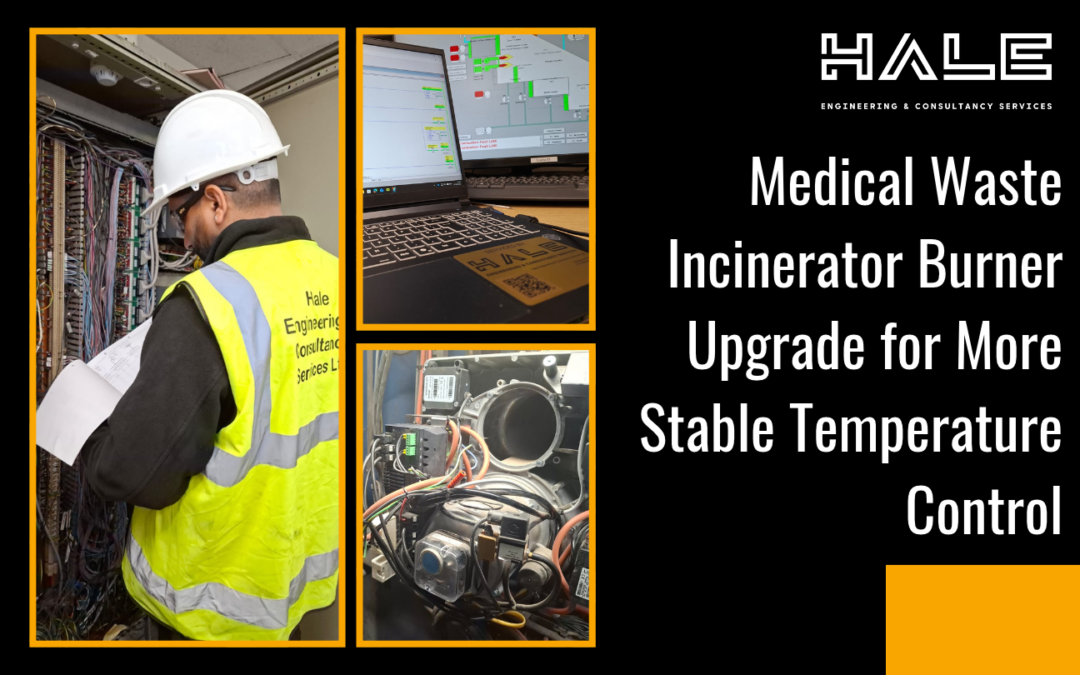
Hale Engineering Consultancy & Services Ltd completed a medical waste incinerator burner upgrade in the UK, integrating five Weishaupt gas burners with an existing Allen-Bradley CompactLogix programmable logic controller (PLC). Its 4–20 mA modulation logic and supervisory control and data acquisition (SCADA) displays were updated. The project report describes steadier temperatures following commissioning.
Project Overview
The incinerator uses primary and secondary combustion chambers. The project covered two primary burners, two secondary afterburners and an anchor burner supporting secondary-chamber operation. Hale Engineering handled installation, control programming, integration and commissioning, retaining the existing PLC.
Operational Challenge and Risks
Existing high/low-fire staging could not continuously match burner output to changing thermal demand. Project notes describe temperature swings and elevated gas use, while identifying a risk of burner firing before a slide plate was fully open. The PLC also lacked spare analogue channels, and some legacy conductors were unmapped.
Engineering Assessment
Engineers reviewed chamber-temperature and gas-flow trends, inspected the PLC installation, and traced field signals. Point-to-point continuity checks helped establish the existing wiring and interlocks. This identified two integration requirements: add analogue input/output capacity for modulation and confirm slide-plate position before permitting ignition.
Hale Engineering’s Medical Waste Incinerator Burner Upgrade
Hale Engineering installed five burners, new power feeds and screened twisted-pair signal cables to limit interference, and expanded the CompactLogix input/output (I/O) capacity. Studio 5000 programming introduced proportional-integral-derivative (PID) temperature control, using chamber-temperature feedback to regulate 4–20 mA burner-demand signals. Revised starting logic combined a hardwired slide-plate-open position switch with a PLC firing permissive and a 10-second delay.
Equipment and Control Strategy
Three Weishaupt WG30N/1-C ZM-LN units served the two primary positions and anchor position; two WM-G10/4-A ZM units served the secondary chamber. The PLC received a 16-channel analogue-input module and an eight-channel analogue-output module in slots 25 and 26. Primary burners modulate while running; secondary afterburners respond to chamber temperature, with the anchor burner providing additional heat when required. Wonderware InTouch screens were updated with burner status, trends, alarms and manual/automatic selectors.
Installation, Integration, Testing and Commissioning
Commissioning included end-to-end analogue loop checks using a signal generator and milliammeter, slide-plate travel and trip tests, and checks of purge timing, shut-off valves and pressure-switch trips. A separate loose 24 V DC conductor was located during pre-start fault finding and the fault cleared before energisation. The updated PLC programme was backed up and cold-restart operation checked.
Results and Operational Benefits
The documented deliverables were five integrated modulating burners, additional PLC I/O, revised control logic and updated operator displays. The project report describes steadier temperatures and lower natural-gas use, but supplies no comparative temperature data, consumption figures or emissions-test results. The SCADA changes provide better visibility of burner states and alarms.
Why This Engineering Approach Matters
For maintenance managers, this medical waste incinerator burner upgrade illustrates why burner replacement must be assessed alongside control capacity, existing wiring and ignition permissives. Retaining the PLC avoided a full controller replacement while enabling continuous modulation.
Frequently Asked Questions
Why was modulation introduced? Existing high/low staging could not vary burner output continuously as chamber demand changed.
Was the existing PLC replaced? No. Expansion modules added the analogue channels needed for 4–20 mA signals.
How was slide-plate position checked? The project documents hardwired open-position feedback, PLC timing logic and functional travel/trip testing.
Sites considering burner modulation or upgrades to existing PLC controls can discuss their equipment and integration requirements with Hale Engineering.
Have a project in mind?
If this case study sparked an idea, we’d be happy to hear about it.
Fill in your details below and we’ll get in touch.