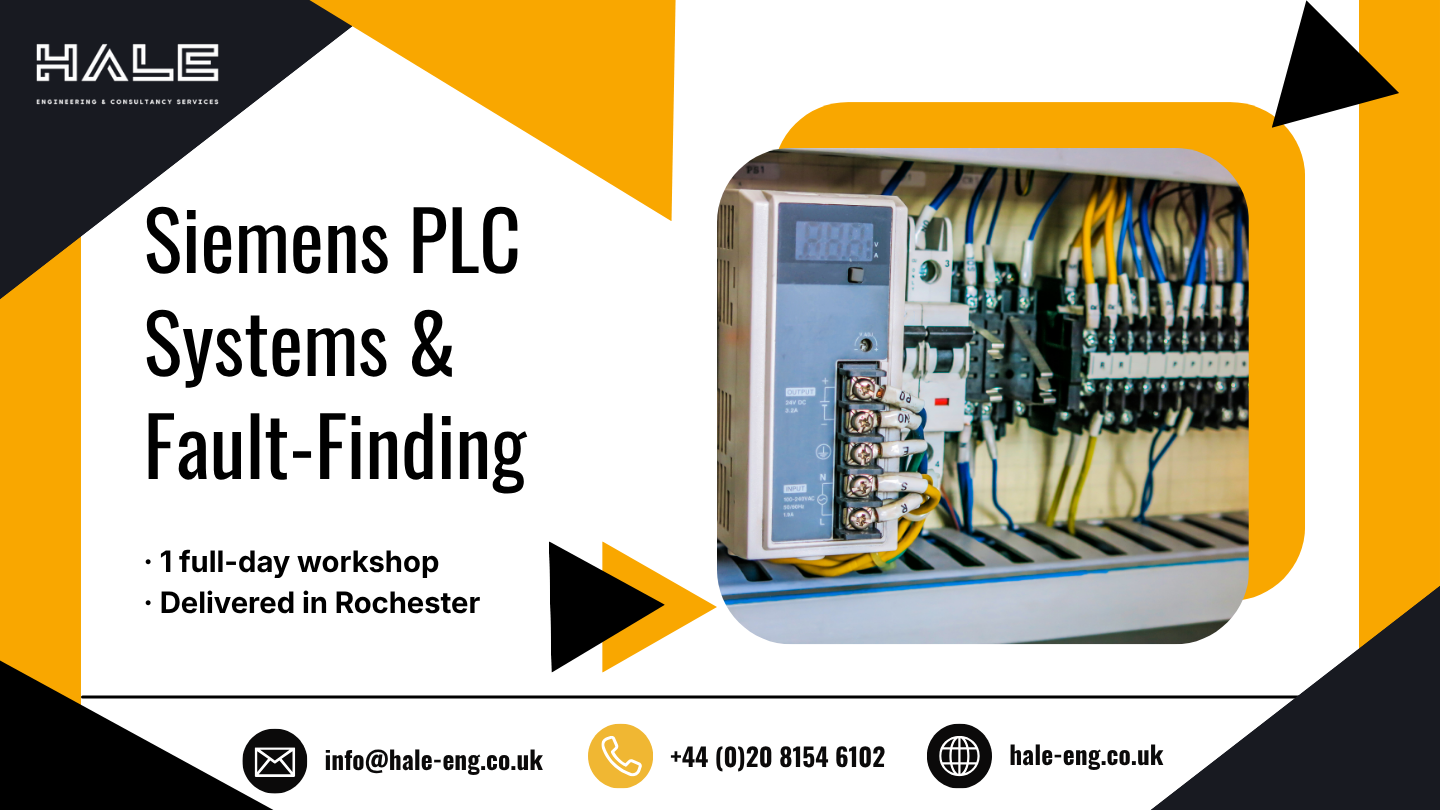
Siemens PLC Systems & Fault-Finding
1 full-day workshop · Delivered in Rochester
This practical one-day workshop is designed for maintenance engineers, automation technicians and senior operators who need to diagnose faults with more confidence, more clarity and less guesswork. It is aimed at teams who want to move beyond simply spotting an alarm or indicator and instead understand what the system is doing, where a fault may be occurring and how to investigate it safely and methodically. The workshop can be tailored to site-specific requirements or delivered as broader fault-finding guidance for teams looking to strengthen their Siemens PLC knowledge. Delivered at our workshop, the training is hands-on throughout and focused on real-world troubleshooting rather than passive theory.
During the workshop, attendees will learn:
- – how Siemens hardware is structured, including the relationship between the backplane, power supply, CPU and I/O modules
- – how to understand hardware configuration and the way a control system is built
- – what LED states mean across different modules and how to use them as part of fault diagnosis
- – how to identify faulty modules and replace them safely
- – the meaning of programme scan and scan time, and how this affects system behaviour
- – how to understand CPU modes such as RUN, STOP and PROGRAM, and when each is relevant
- – how to check whether forcing is active and what this means in practice
- – how to identify CPU battery condition and carry out the correct replacement procedure
- – how to open the correct toolset and project, and understand the difference between offline and online modes
- – how to interrogate the diagnostics buffer and use cross-reference tools to navigate the software effectively
- – how to view symbols, comments and documentation to better understand the programme
- – how to monitor the programme online and trace logic to find where power flow stops
- – how Profibus and ProfiNet networks work, and how to approach network fault-finding
What we need from you beforehand:
- – a list of plant systems to be covered
- – details of the Siemens software versions currently in use on site
- – relevant wiring diagrams and system diagrams
- – O&M documentation showing how the plant operates
Logistical details:
- – Full-day workshop delivered at our workshop facility
- – Suitable for maintenance engineers, automation technicians and senior operators
- – Content can be tailored to your plant and systems, or delivered as more general Siemens fault-finding training
- – Practical, hands-on delivery is standard throughout
- – This training course can be booked for one or more engineers
Book your place:
Standard delivery: Hale Engineering workshop, Rochester
All courses are delivered as standard at our workshop, Units 7 & 8 Riverside, Sir Thomas Longley Road, Medway City Estate, Rochester, Kent, ME2 4DP. Workshop delivery is included in the course price.
On-site delivery: Available as a bespoke add-on. Priced on enquiry based on location and site requirements.
Training delivered by working engineers
Hale Engineering has been diagnosing faults, commissioning control systems, and managing functional safety on industrial sites across the UK for years. Our clients include Rolls-Royce, BMW, Coca-Cola, Wessex Water, Stericycle and Biffa. Our training is a direct extension of that work. Every course is delivered by practising engineers — not trainers who once worked in industry. We design each programme around your systems, your documentation, and the faults your team actually faces. There is no generic curriculum. There is no substitute for it.
Bespoke workshops also available
Not every requirement fits a standard format. Hale Engineering can also design bespoke workshops around a wide range of industrial control and safety needs. This includes PLC fault-finding, SCADA and HMI operation, machine safety, LOTO procedures, control panel documentation, and sector-specific fault-finding programmes. If your team has more specific requirements or wider skills gaps to address, we can scope and price a workshop accordingly.
To discuss your requirements, request a proposal or ask any questions, contact us directly. We respond promptly and without sales theatre.
info@hale-eng.co.uk | +44 (0)20 8154 6102