
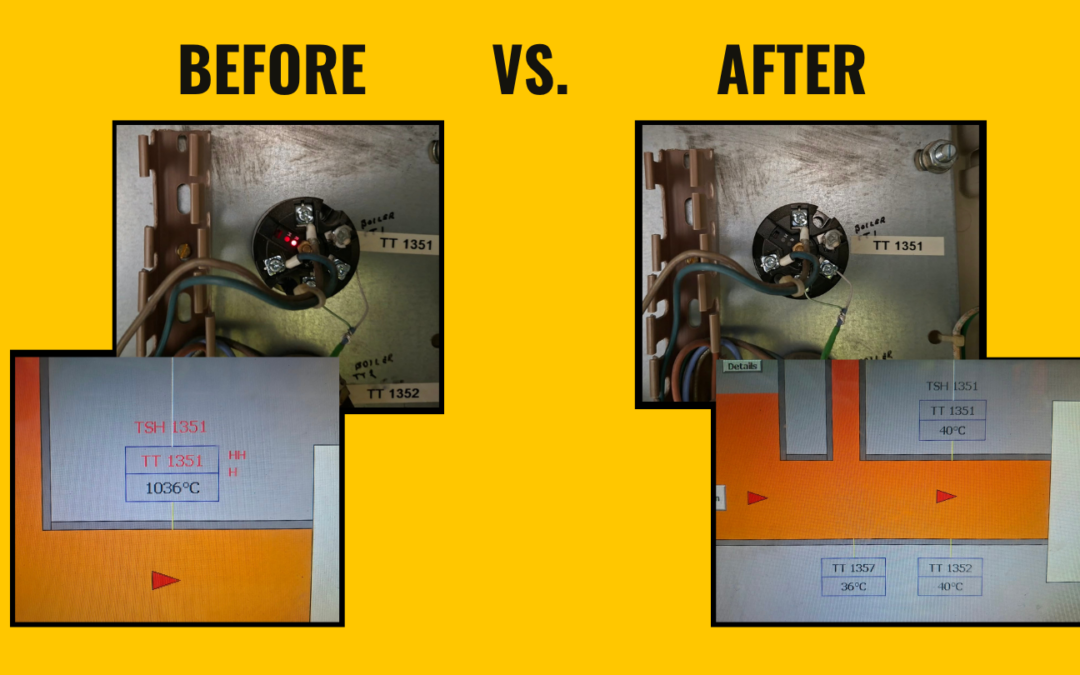
Hale Engineering Consultancy & Services Ltd completed a thermocouple cable replacement on four temperature loops serving a rotary kiln and waste heat recovery boiler at a clinical waste incineration facility. Engineers traced unstable signals to degraded cabling and sensor-head connections, replaced the extension runs, remade terminations and restored stable offline readings.
Project Overview 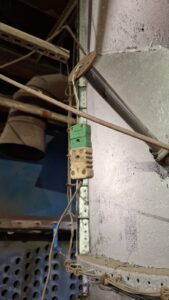
The work covered boiler outlet loops TT1351, TT1352 and TT1357, plus rotary kiln loop TT1301. The Type K signals feed the distributed control system (DCS) / supervisory control and data acquisition (SCADA) interface used for process temperature monitoring.
The scope combined instrumentation fault finding with damaged signal-cable replacement.
Operational Challenge and Risks
Before intervention, TT1351 drifted and spiked to 1036°C, generating high and high-high alarm/trip conditions. Because these temperature signals are used by dilution-air and override logic, unreliable readings could trigger incorrect control responses and nuisance trips while reducing confidence in process indication.
Engineering Assessment
Engineers audited terminations in junction box JB114, inspected the thermowell assemblies and checked sensor-head connections. The assessment identified degraded instrumentation cabling and intermittent open- or short-circuit conditions at the sensor heads, with heat exposure and mechanical stress recorded as contributing factors.
Hale Engineering’s Thermocouple Cable Replacement
Four signal runs were replaced. New extension cables were routed from probe connection blocks through strain-relief service loops and the existing galvanised cable tray, then secured to reduce vibration exposure and avoid local hot spots.
The TT1351 transmitter terminations in JB114 were rewired to remove high-resistance contact points.
Equipment and Control Strategy 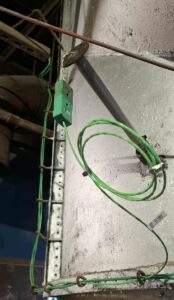
The replacement used Type K (KX) extension cable matched to Chromel/Alumel thermocouples, with PFA/PTFE insulation, a PFA outer jacket and an overall foil screen with drain wire. Existing thermowell assemblies were inspected; no thermowell or transmitter replacement is recorded.
Installation, Integration, Testing and Commissioning
Following termination, transmitter status indicators were reported green and operational. With the plant offline, the previously erratic 1036°C indication returned to approximately 39–40°C, and the associated “Safety Override Active” and default dilution-air interlock fault states reset.
No separate long-term trend test, production trial, factory acceptance test or site acceptance test is documented.
Results and Operational Benefits
The work removed the faulted high-temperature condition from the monitored loop and restored plausible, stable offline readings. It also cleared the associated control-system fault states.
Longer-term reductions in nuisance trips, downtime or maintenance intervals were not quantified, so these remain expected benefits rather than measured results.
Why This Engineering Approach Matters 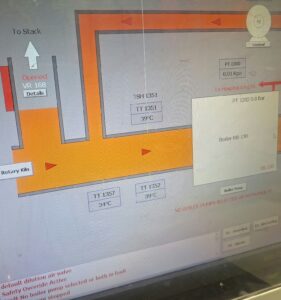
Thermocouple systems use low-level millivolt signals, so degraded cable or poor connections can create large apparent temperature errors. This thermocouple cable replacement addressed the complete signal path—sensor connection, cable route, junction-box termination and control-system indication—rather than replacing instruments without confirming the fault source.
For waste-to-energy plant managers, this supports more dependable temperature feedback and targeted maintenance decisions.
Frequently Asked Questions
What caused the unstable temperature readings?
The report identified degraded signal cabling and intermittent open- or short-circuit conditions at sensor-head connections, with thermal and mechanical stress contributing.
Why was Type K extension cable used?
The sensors were Type K thermocouples, so matching KX extension cable was used to preserve the correct thermoelectric signal characteristics between the sensors and measuring system.
How was the repair verified?
The offline reading stabilised at approximately 39–40°C, transmitter status indicators were operational, and the associated control-system fault states reset.
If your site has unstable thermocouple signals, damaged instrumentation cabling or difficult temperature-loop faults, Hale Engineering can review the equipment and define an evidence-based repair scope.