
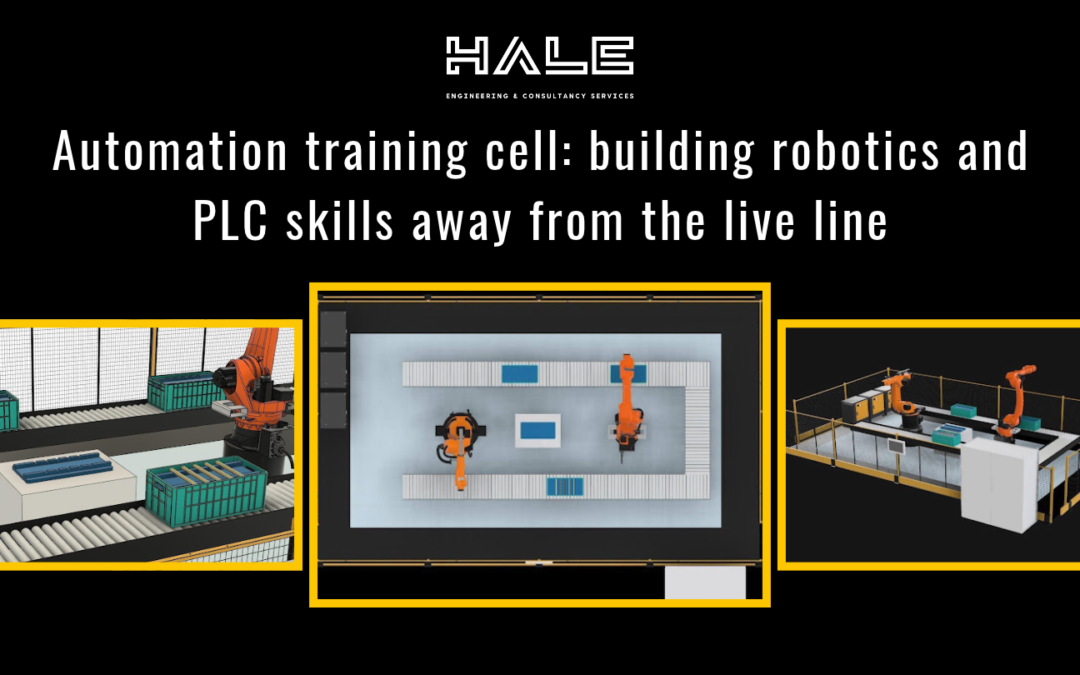
Every manufacturer that invests in automation eventually faces the same question: who is going to keep it running? This case study follows the design of a dual-robot training cell that lets operators, maintenance engineers and apprentices learn on real equipment, make real mistakes and find real faults, long before anyone trusts them with a live production.
Why this case study matters
Automation has changed what a good engineer needs to know. A maintenance technician who once worked mainly with motors, belts and relays is now expected to read a PLC program, recover a robot after a safety stop and understand why a light curtain has brought a whole cell to a halt. The equipment has become far more capable, and the skills needed to look after it have grown with it.
The industry feels this keenly. Make UK research found that 46% of manufacturers say a lack of technical skills makes it harder to adopt automation; in other words, the robots are available, but the people who can confidently run and repair them are not always there.
Traditionally, those skills have been learned on the job, beside an experienced colleague, on the very line that pays the wages. That tradition has served British manufacturing well for generations, and the instinct behind it is sound, because there is no substitute for real equipment. The difficulty is that a modern automated line makes a poor classroom. Every hour spent training on it is an hour of lost output, and the faults a trainee most needs to practise are exactly the ones nobody wants to see.
This case study shows another way: one that keeps everything valuable about learning on real equipment while taking the production risk out of it. It describes how Hale Engineering designed a bespoke automation training cell for a leading UK manufacturer, and explains the reasoning behind each design decision.
Who should read it
It is written for engineering, maintenance and operations managers at UK manufacturers who are responsible for keeping automated equipment running, and for the training, apprenticeship and HR leads asked to build the skills to do it. If your teams work with robots, PLCs or conveyors, and you have ever postponed training because the line could not be spared, this project will feel familiar.
What you will learn
By the end, you will understand what an automation training cell is and the problem it solves. You will see how a cell can be built around the robots and control platform you already use, why faults need to be designed into training rather than left to chance, and what a turnkey project includes, from the first concept through to handover and compliance documentation.
What to look out for
As you read, notice three decisions in particular. The cell uses the client’s own robots and control hardware rather than generic training kit; faults are built in deliberately through dedicated fault stations; and the safety systems and paperwork match those on a live production line. Together, these are what turn a piece of training equipment into a genuine bridge between the classroom and the shop floor.
| Sector | Manufacturing |
| Client | Leading UK manufacturer |
| Application | Workforce automation training |
| Platforms | Siemens S7-1500 PLC, KUKA 6-axis robots |
| Hale scope | Design, build, programme and commission |
| Stage | Concept design |
The challenge: the only classroom was the production line
The client’s production operators, maintenance engineers and apprentices were all expected to work confidently on robots, PLCs and conveyors. That expectation is entirely reasonable; the problem was where the experience had to come from.
The only equipment available to learn on was the equipment running production. So every training exercise had to be negotiated around output targets, and every mistake carried a real cost, whether in downtime, damaged product or, most seriously, risk to people. It is a familiar trap. Training gets squeezed into whatever time the line can spare, which is rarely enough, and engineers often meet a fault for the first time when it is happening for real, with the clock running.
So the client wanted a dedicated training asset that behaved like a real production cell, with the same control platform, the same safety systems and the same types of faults its teams face on the shop floor. The hardware had to be real and the faults had to be realistic; the only thing missing would be a production schedule waiting on the result.
Our approach: a training cell that behaves like production
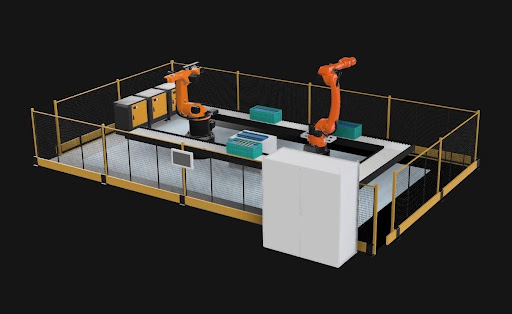
Hale Engineering developed a concept for a bespoke dual-robot automation training cell, engineered to replicate real production conditions in a controlled environment. The design rests on one simple principle: people should practise on what they will actually face on the shop floor. Each of the decisions below follows from it.
Real equipment, not a simulator
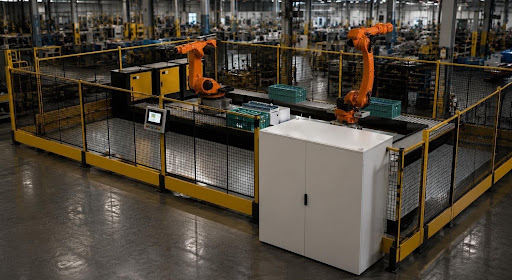
The cell integrates the client’s own KUKA 6-axis robots and Siemens S7-1500 control hardware, so trainees learn on the same platforms they will maintain on site. That matters more than it might first appear, because knowing where to look on a familiar HMI, or how a particular robot behaves after an interlock trip, is exactly the knowledge that shortens a breakdown at three in the morning.
A cycle that keeps everything working together
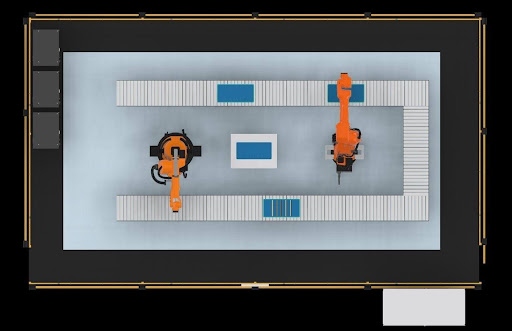
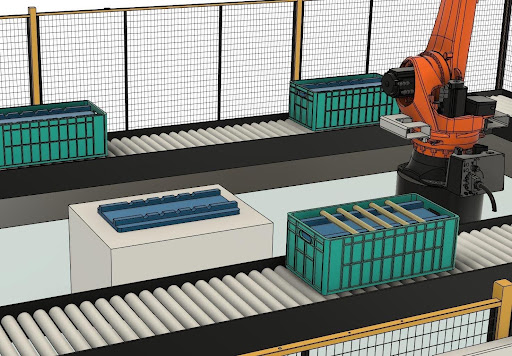
Two robots share a continuous pick-and-place cycle around a U-shaped Rulmeca motorised drive roller conveyor, with PLC-controlled indexing and stop positions. Because the robots, the conveyor and the control system all depend on one another, trainees see how a problem in one area ripples through the whole cell, just as it would in production. The cycle runs like this:
- An empty tray is delivered to Robot 1, which loads parts from a central table.
- The loaded tray travels along the conveyor to the far side of Robot 1.
- Robot 1 turns and unloads the parts back to the central table.
- The empty tray continues to the end of the conveyor.
- Robot 2 transfers the empty tray back to the start of the conveyor, and the cycle repeats.
Faults by design, not by accident
On a live line, faults arrive whenever they please, and nobody is glad to see them. In the training cell, they are planned. Dedicated fault stations allow instructors to set up structured fault-finding exercises across electrical, mechanical and control disciplines, so a trainee can work through the same fault until the diagnosis becomes second nature, and every trainee can be assessed against the same scenario.
The same safety systems as the shop floor
The cell is protected by Axelent perimeter guarding, Keyence light curtains and a full safety interlock system. Trainees therefore learn to work with the same safeguards they will meet on a production line, which means good safety habits are formed in training rather than corrected later on the shop floor.
Three levels of access for three kinds of learner
Control runs through a Siemens S7-1500 PLC with a 21.5-inch Unified Comfort HMI offering three access levels: Operator, Setter and Maintenance. So an apprentice can begin by running the cell, progress to setting it, and eventually take on maintenance tasks, all on the same equipment and at a pace that suits their development.
Documentation to production standards
Finally, the cell comes with the compliance package you would expect of any production system: a CE technical file, PUWER assessment, O&M manuals, electrical drawings, PLC source code and a TPM plan. Training equipment is still equipment, and it deserves the same rigour as anything else on site.
Built to the same standards we apply to live production systems, so what trainees learn in the cell transfers directly to the shop floor.
Our scope: one partner from concept to handover
Hale Engineering takes full turnkey responsibility for the cell, which means the client deals with one engineering partner rather than a chain of suppliers. Our engineers carry out the mechanical, electrical and controls design, supported by FMEA and concept design reviews, before moving on to manufacture: the control panel build and wiring, the conveyor, the robot pedestals and the centre fixture with its fault stations.
On the software side, we programme the PLC and HMI, write the fault logic and training scenarios, and develop the robot interlock sequences. We then install and commission the cell on site, with factory and site acceptance testing, and hand over a full documentation package alongside documented on-site training. Throughout the project, a single point of contact manages logistics, transport and delivery, so the client always knows exactly who to call.
Why this project matters
The problem solved
At its heart, this project separates learning from production. Trainees can make mistakes and find faults without risk to people, product or output, and training no longer competes with live lines for equipment or downtime. Because the cell uses the same robots, PLC platform and safety systems as production, what people learn in it carries straight onto the shop floor; and because the fault scenarios are repeatable, the client gains a consistent way to assess operators, maintenance engineers and apprentices against the same standard.
What this project tells us about training on automated equipment
Look beyond the hardware and four lessons stand out, which apply to any manufacturer weighing up how to build automation skills.
Train on what you run. Generic training kit teaches general principles, but engineers fix specific machines. Building the cell around the client’s own platforms closes the gap between what is taught and what is maintained.
Design the faults in. Fault-finding improves with repetition, and repetition is impossible if you wait for faults to happen on their own. Structured, repeatable scenarios turn chance encounters into a proper training programme.
Hold training to production standards. Guarding, interlocks and documentation should match the shop floor, because the habits people form in training are the habits they take onto the line.
Treat training as an asset, not an interruption. Once training has its own equipment, it can be planned, scheduled and measured like any other part of the operation, rather than squeezed into whatever downtime the line allows.
What happens next
The training cell is currently at concept design stage, with Hale Engineering responsible for every step from here to handover, and we look forward to sharing how the client’s teams put it to work once it is commissioned. In the meantime, the principles behind it apply to any manufacturer whose people are still learning on the line that pays the bills.
Frequently asked questions
What is an automation training cell?
An automation training cell is a dedicated, guarded cell that uses real industrial robots, PLCs, conveyors and safety systems to recreate production conditions away from the live line. Engineers can operate, monitor and fault-find the equipment without affecting output or putting people and product at risk.
Who is a training cell designed for?
Production operators, maintenance engineers and apprentices. In this design, the HMI has three access levels (Operator, Setter and Maintenance), so each group can train at the right depth, while repeatable fault scenarios allow consistent assessment across all three.
Can a training cell be built around our existing robots and PLC platform?
Yes, and that is largely the point. This design integrates the client’s own KUKA robots and Siemens control hardware, so trainees learn on the platforms they will actually maintain. Hale Engineering works across both Siemens and Rockwell platforms.
Does a training cell replace on-the-job training?
No; it prepares people for it. Engineers still need time on the shop floor beside experienced colleagues, but they arrive having already operated, set and fault-found the same equipment, so their time on the line is spent applying skills rather than learning the basics under pressure.
What compliance documentation comes with the cell?
The cell is designed to the same standards Hale applies to live production systems and comes with a full compliance package: a CE technical file, PUWER assessment, O&M manuals, electrical drawings, PLC source code and a TPM plan.
Is your team still learning on the live line?If your operators, maintenance engineers or apprentices are building their skills on the equipment that keeps your business running, there is a safer and more structured way to do it. Talk to us about a training cell designed around your platforms, your processes and the faults your teams actually face; we will help you work out what it should include and whether it makes sense for your site. Email info@hale-eng.co.uk Call +44 20 8154 6102 Prefer to start with your people rather than your equipment? We also run hands-on PLC fault-finding workshops for Siemens and Allen-Bradley platforms, both as public courses and tailored to your site. |
About Hale Engineering
Hale Engineering & Consultancy Services (HECS) is a controls design, commissioning and functional safety engineering firm based in Rochester, Kent. We work across Siemens and Rockwell platforms, delivering automation for manufacturing, waste-to-energy, water and chemical clients across the UK.