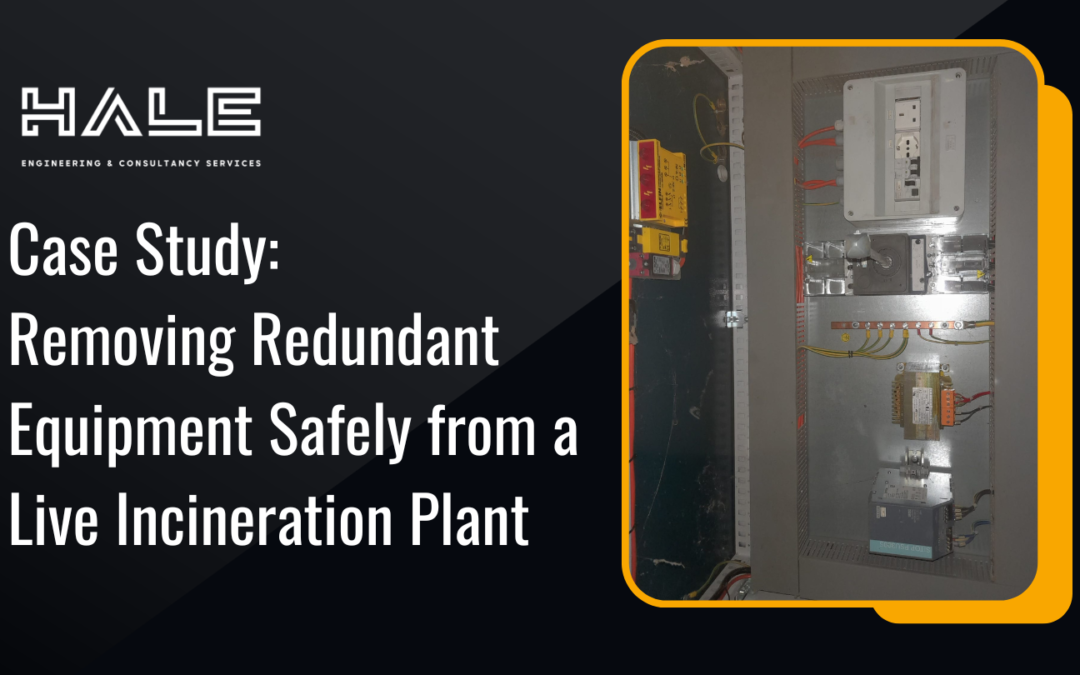
Removing redundant equipment from a live incineration plant can be technically demanding, especially when redundant equipment remains connected to operational systems. In older industrial plants, legacy cabling, historical modifications and equipment changes can create hidden risks for fault-finding, maintenance, safety and long-term reliability.
This case study shows how Hale Engineering supported the safe removal of redundant equipment and associated cabling from a live incineration plant, without major disruption to plant operation. The work required careful planning, correct identification of live systems and controlled disconnection to protect the client’s operation. This work reflects Hale Engineering’s wider support for industrial automation, PLC and control systems, machine safety and electrical compliance across UK industrial sites.
Client Challenge
The client needed to remove redundant equipment and associated cabling within a very short time period. At first, the task appeared straightforward. The real challenge was that the redundant equipment was still directly connected to operational systems that needed to remain live and available for production.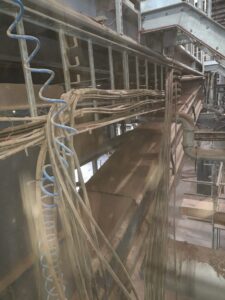
This meant the work could not be treated as a simple disconnection and removal exercise. Every connection, node and interface had to be correctly identified before any physical work could begin. An incorrect isolation, removal or assumption could have affected live plant systems, caused unnecessary downtime, or introduced additional safety risk for the site team.
For senior engineering managers and site managers, this is a familiar problem on older industrial sites. Over time, plants are adapted, modified and extended to keep production moving. Equipment may become redundant, but the associated cabling and connections are not always removed immediately. While this can support short-term continuity, it often creates longer-term issues for maintenance teams, especially during breakdowns or planned works.
In practical terms, the task was similar to replacing a wheel on a car while the car is travelling at speed. The objective was clear, but the working environment made the job sensitive, time-critical and technically demanding.
Hale Engineering’s Approach
Hale Engineering worked closely with the plant control engineers to plan the work before any equipment was disconnected. This planning stage was essential to understand how the redundant equipment was connected, what remained operational, and how the work could be completed safely while protecting live plant operation.
The team reviewed the system, identified the correct nodes, confirmed which equipment could be safely disconnected, and agreed the sequence of work. This controlled approach reduced the risk of disturbing operational equipment and gave the site team confidence that the task could be completed without unnecessary disruption.
Clear communication with the plant team was also important. When work is carried out on live industrial systems, technical accuracy must be supported by good coordination, careful decision-making and a clear understanding of operational priorities.
The Engineering Solution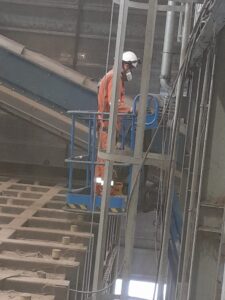
Once the correct method had been agreed, Hale Engineering disconnected the redundant equipment and associated cabling in a structured and safe manner. The work was completed under time pressure, but without compromising the operation of the plant.
The focus was not only to remove unwanted equipment, but to improve the condition of the remaining system. By removing redundant components and unnecessary cabling, the plant environment became clearer, easier to understand and easier for maintenance teams to work with in the future.
Project Outcome
The result was a cleaner and more manageable plant environment, with redundant equipment removed and unnecessary cabling no longer complicating the system.
For the client, this delivered several practical benefits:
- improved plant organisation;
- easier fault-finding and troubleshooting;
- reduced confusion around obsolete equipment;
- better visibility for maintenance teams;
- smoother day-to-day operation;
- reduced time wasted investigating equipment that no longer serves an operational purpose.
These benefits are important because maintenance efficiency depends on clarity. When engineers can understand the system quickly, they can diagnose faults faster, respond with more confidence and reduce the time spent tracing redundant or unclear connections.
Why This Work Matters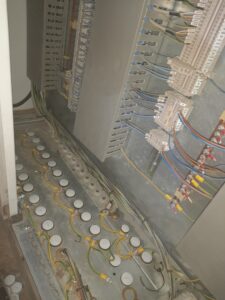
On ageing incineration plants and industrial sites, redundant equipment should not be ignored simply because the plant is still running. Left unmanaged, it can increase maintenance pressure, slow down fault response and create unnecessary operational risk.
This project demonstrates Hale Engineering’s ability to carry out sensitive engineering work safely, under pressure and around live plant systems. It also shows the value of careful planning, technical accuracy and close cooperation with site control engineers. Safe work around electrical equipment should always be supported by suitable planning, isolation and competent engineering practice.
For the client, the outcome was increased efficiency, improved maintainability and a clearer plant environment that supports safer and more reliable operation. For senior site teams, this is the real value: less unnecessary complexity, better control of operational risk and a plant that is easier to maintain when reliability matters most.
Have a project in mind?
If this case study sparked an idea, we’d be happy to hear about it.
Fill in your details below and we’ll get in touch.