
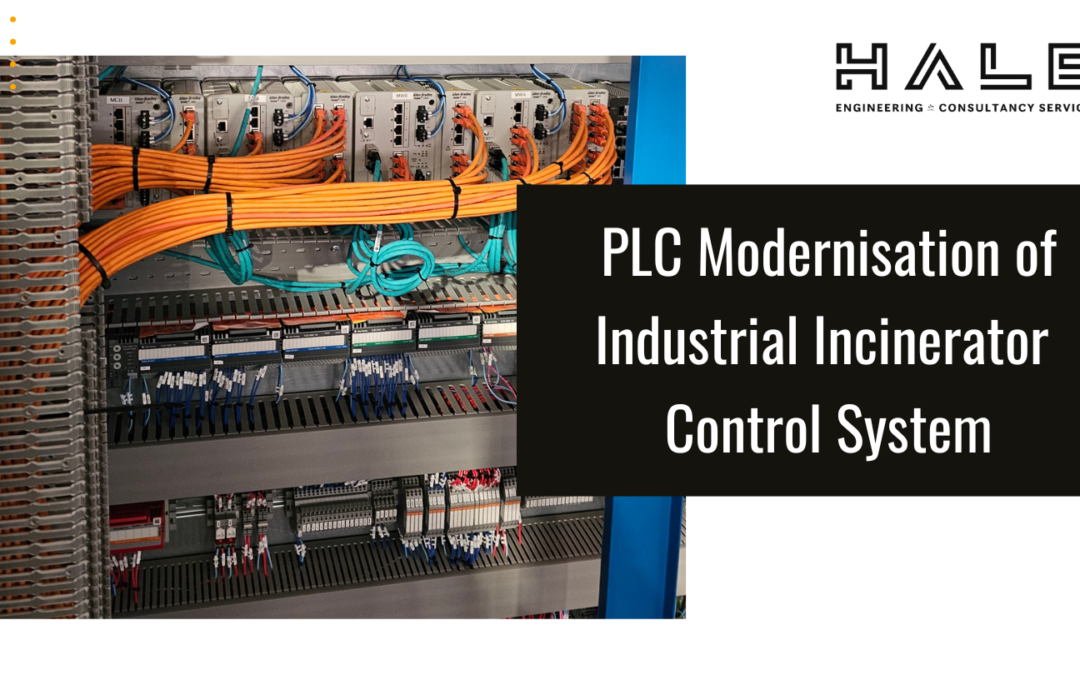
This case study looks at the successful delivery of a major control system upgrade for an industrial incinerator, where long-term reliability, safety and operational resilience were critical.
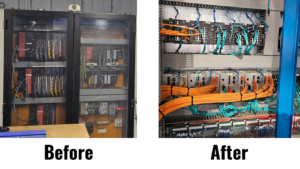
The goal was to replace a 30-year-old Mitsubishi PLC system with a fully modernised Allen-Bradley control architecture, improving diagnostics, maintainability, communication capability and future scalability across the site.
The project involved the migration from legacy PLC technology to an Allen-Bradley PlantPAx-based control system, supported by distributed remote I/O, a dedicated safety PLC system and a modern industrial Ethernet communications network.
Project Overview
The original control system had been in continuous operation for over three decades, supporting critical incineration processes. While historically reliable, the system had become increasingly obsolete due to:
- Obsolete hardware and limited spare availability
- Reduced diagnostic capability
- Increasing risk of unplanned downtime
- Lack of modern communication and integration capabilities
To improve reliability, maintainability, and future operational resilience, a full control system replacement was undertaken.
New Control System Solution
The legacy Mitsubishi PLC was replaced with a modern Allen-Bradley-based control system, utilising PlantPAx (the largest operational example in the UK) as the core distributed control platform.
The upgraded system includes:
- Allen-Bradley PlantPAx DCS/PLC hybrid control architecture
- Distributed remote I/O racks to reduce cabinet density and improve scalability
- Fully segregated and dedicated safety PLC system
- Modern industrial Ethernet-based communications network
- Enhanced system diagnostics and asset-level monitoring
Key Improvements Delivered
Improved Reliability & Maintainability
The new architecture removes dependency on obsolete technology and provides a widely supported platform with long-term availability of hardware, firmware support, and engineering expertise.
Advanced Diagnostics and Visibility
PlantPAx integration provides enhanced diagnostics, asset health monitoring, and improved fault resolution capability, significantly reducing downtime during maintenance activities.
Enhanced Functional Safety
A dedicated, segregated safety PLC system has been implemented, ensuring clear separation between process control and safety functions, improving compliance and overall risk management.
Scalable Future-Ready Platform
The system has been designed to support future expansion, including additional I/O, process upgrades, and integration with higher-level plant systems such as SCADA and enterprise data platforms.
Optimised Control Infrastructure
Remote I/O architecture has reduced hardwired complexity within control panels, improving signal integrity, reducing installation footprint, and simplifying maintenance access.
Outcome
The upgraded system delivers a significant step change in operational capability, providing improved reliability, enhanced safety integrity, and a robust modern automation platform suitable for continuous industrial operation.
The installation of the PlantPAx-based control system ensures the facility benefits from one of the most widely adopted and supported control platforms in the UK industrial sector.
Summary
This project successfully modernises a critical incinerator control system from legacy Mitsubishi PLC technology to a fully integrated Allen-Bradley PlantPAx-based architecture, incorporating distributed I/O and a segregated safety system. The result is a future-proof, scalable, and highly maintainable control solution aligned with current industry best practice.
About Andy Hale
Hale Engineering is led by Andy Hale, a control systems and automation specialist with decades of hands-on industrial experience. Andy has specialist expertise across Siemens, Allen-Bradley and Mitsubishi platforms, supporting complex industrial environments where reliability, safety and operational continuity are critical.